










Earn to Die 2 Game Review

Additional Information:
Screenshots
Editor's Review:
Updated 2026-06-16
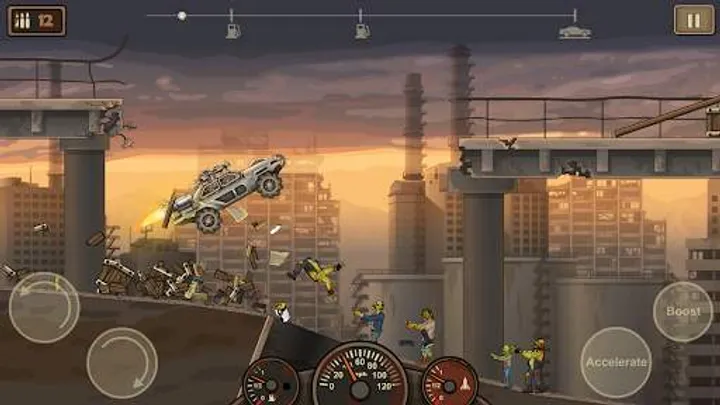
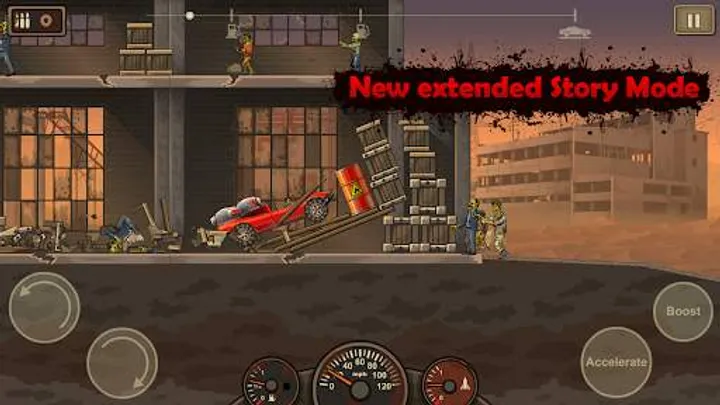
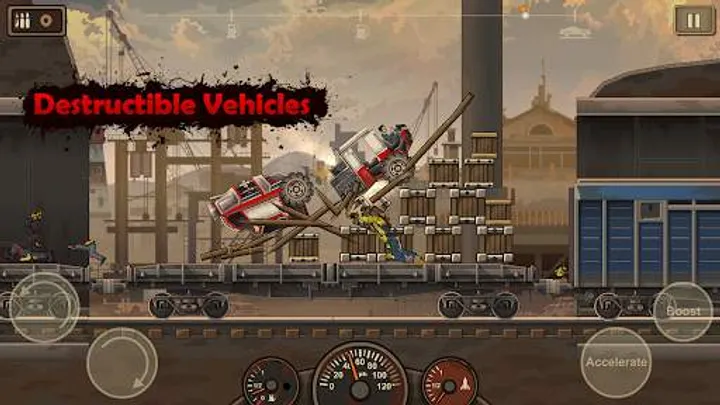
Earn to Die 2 is the kind of mobile car game that understands why short runs can become surprisingly hard to put down. You do not come to it expecting a quiet Sunday drive or a strict simulation of perfect racing lines; you come to it for momentum, survival pressure, upgrades, and the feeling that a battered vehicle can be pushed a little farther than it managed on the previous attempt. As a free Android and iOS game released on 2015-05-04, it sits in that familiar mobile arcade space where progress is measured in small gains, repeated attempts, and the satisfaction of turning a weak first run into something more forceful. The game’s appeal is not simply that it belongs to the cars category, but that it treats each drive as a test of endurance. You are not just trying to be fast. You are trying to keep moving, stretch your distance, and make each improvement count. That is why the tagline fits so well: the game makes every small victory matter. A few extra meters, a smoother section, or a better upgrade choice can feel meaningful because the structure constantly nudges you to compare your current attempt with the last one. It is very much a mobile arcade experience, but one with a strong loop: drive, earn, improve, repeat, then feel the difference when your vehicle starts behaving like something built for survival rather than something barely ready for the road.
The first thing to understand is that Earn to Die 2 is built around expectation management. You should not expect to clear everything immediately or glide through the game on pure reflex alone. The enjoyment comes from gradually pushing through resistance. You begin with modest capability, and the road ahead is designed to make you aware of every limitation. Your vehicle may not carry you as far as you want at first, and that is intentional. The game wants you to feel friction, to run out of momentum, to fall short, and then to return with a better setup. That loop gives the experience its survival flavor. While it is categorized as a cars, racing, survival, and arcade game, its racing identity is less about competing against a traditional pack and more about racing against the demands of the route itself. You are always trying to convert motion into progress. Instead of long, complex rules, the game keeps the focus direct: drive forward, deal with the obstacles of the journey, earn what you need, and make the next attempt stronger. This is practical mobile design, especially on Android and iOS, because it makes even a short session feel complete. You can play for a few minutes and still leave with a sense that something changed. Maybe you did not break through as far as you hoped, but you likely learned where the run went wrong, what upgrade might help, or how to handle the pacing of the next attempt.
What gives the game its pull is the way it turns repetition into visible progress rather than empty grinding. In weaker arcade games, replaying the same kind of run can feel like being sent back to the start for no good reason. Here, the cycle works because each run feeds the next. You begin to understand the rhythm: conserve movement where you can, push when the track allows it, and accept that not every drive is going to be graceful. There is a scrappy energy to the experience. The cars are not presented as delicate machines to be polished and parked; they are tools for getting through a dangerous route. That distinction matters because it changes how you approach the game. You are encouraged to think in terms of utility. If an improvement helps you last longer, climb better, accelerate more effectively, or simply avoid wasting your attempt, it has value. The game does not need to overwhelm you with complex strategy to create choice. Instead, it asks you to care about practical decisions. What is holding you back right now? Are you losing too much speed? Are you failing to carry momentum through rough stretches? Are you reaching a point where your current setup simply cannot continue? The best moments arrive when an upgrade or adjustment transforms a previously frustrating stretch into something you can finally overcome. That is when Earn to Die 2 feels most rewarding: not because it hands you a huge cinematic victory, but because it lets you feel the mechanical difference between yesterday’s failure and today’s progress.
As a mobile game, Earn to Die 2 benefits from being easy to understand without feeling completely disposable. The 77.5 MB size keeps it in a reasonable range for a phone or tablet game, and its availability on both Google Play and the App Store makes it accessible to the two major mobile audiences. It is also important to set expectations about platform reach: this is not listed for Steam, PlayStation, Xbox, Nintendo, or an official website in the supplied store details, so you should treat it first and foremost as an Android and iOS title. That mobile identity shapes the experience. Sessions can be short, runs can be repeated quickly, and progress does not require you to sit down for a long evening as though you were starting a full console racer. At the same time, the game has enough of an upgrade-driven structure to keep you thinking beyond a single attempt. You can jump in quickly, but you may find yourself saying, “one more run,” because the next improvement feels close. That is a classic arcade hook, and Earn to Die 2 handles it confidently. It does not need to dress itself up as a deep simulation or a technical motorsport game. It knows that its strength is the feedback loop between effort and reward. You play, you fall short, you improve, and the next road segment feels a little more possible.
The direct second-to-second experience is about maintaining momentum under pressure. You are not simply watching a vehicle roll forward; you are participating in a constant negotiation between speed, control, survival, and distance. The game’s challenge comes from making the road feel like something you have to earn your way across. This is where the arcade style is strongest. It is approachable, but not passive. You need to pay attention to how your vehicle behaves and how your decisions affect the run. If you treat every attempt as identical, you may miss the little efficiencies that help you stretch farther. If you push carelessly, you may waste the opportunity that your latest upgrade gave you. The game is not asking for the precision of a hardcore racing simulator, but it rewards awareness. You begin to recognize that even a small improvement can matter because the structure is built around incremental success. That can be especially satisfying for players who like visible progression. You are not stuck wondering whether you are improving; the game makes improvement tangible through distance, performance, and the feeling that your car is becoming more capable. This sense of growth is the heart of the experience. It gives purpose to repeated runs and keeps the survival theme from being merely decorative. You are surviving by upgrading, learning, and forcing your way forward little by little.
The free price also influences how the game should be judged. For a free cars game on Android and iOS, Earn to Die 2 offers a strong reason to try it if you enjoy arcade driving with progression. The score of 4.5 reflects a game that is clearly effective at what it sets out to do: provide a compact but compelling loop where driving, earning, and upgrading reinforce each other. You should not approach it expecting an open-ended racing platform with every modern feature across every device family. The supplied store information points to mobile only, and the genre listing is straightforward: Cars. Within that frame, it succeeds by making the simple act of pushing forward feel dramatic. There is tension in not knowing whether the current run will be enough, and there is satisfaction in realizing that the next run might be. The game is also friendly to players who prefer clear goals over complicated menus. You can understand the basic appeal almost immediately, then stay for the layered feeling of gradually improving your chances. Its best audience is someone who enjoys arcade vehicle games, survival-tinged progression, and the steady reward of turning repeated failure into forward movement. If you need highly technical racing, official licensed circuits, or multiplayer competition, the available facts do not point in that direction. But if you want a car-focused mobile game where distance, upgrades, and persistence form the backbone of the fun, Earn to Die 2 is easy to recommend.
What ultimately makes Earn to Die 2 memorable is not a single feature, but the consistency of its central promise. It asks you to believe that the next attempt can be better, and then it gives you enough feedback to make that belief feel reasonable. That is a powerful formula for mobile play. You may start a run expecting only a small gain, then suddenly pass a previous sticking point and feel the whole game open up by a few more seconds. Those moments are modest, but they are exactly what keep an arcade progression game alive. The cars theme is used in a practical, physical way: movement matters, upgrades matter, and the condition of your progress is always tied to how far you can force the vehicle forward. As a survival arcade racer available free on Google Play and the App Store, it remains a strong pick for players who like their driving games rougher, more progression-focused, and less concerned with polished racing etiquette. Earn to Die 2 does not need to be complicated to be effective. It simply needs to make you care about the next stretch of road, and it does that with confidence. By the time you have failed a few times, improved your vehicle, and finally pushed farther than before, you understand the appeal clearly: every run is a chance to prove that the last one was not the limit.
Download links point to official app marketplaces such as Google Play and the App Store when available. Always review store details before installing.
FAQ
What is Earn to Die 2?
Earn to Die 2 is a cars game with racing, survival, and arcade elements. It focuses on repeated driving attempts, progression, and the satisfaction of pushing farther with each improvement.
What platforms is Earn to Die 2 available on?
Earn to Die 2 is available for Android and iOS. The supplied store information does not list Steam, PlayStation, Xbox, Nintendo, or an official website version.
Is Earn to Die 2 free to play?
Yes, Earn to Die 2 is listed as Free. It is available through Google Play and the App Store according to the provided store details.
What kind of gameplay should I expect from Earn to Die 2?
You should expect arcade-style car gameplay built around survival pressure and steady progress. The core appeal is driving as far as possible, learning from each attempt, and improving your performance over time.
Is Earn to Die 2 worth playing?
Earn to Die 2 is worth trying if you enjoy mobile car games with a strong upgrade-and-repeat loop. With a 4.5 score and free availability on Android and iOS, it is an easy recommendation for players who like arcade driving that rewards persistence.
Editor's Choice Games





















Additional Information:
Screenshots
Editor's Review:
Updated 2026-06-16
Earn to Die 2 is the kind of mobile car game that understands why short runs can become surprisingly hard to put down. You do not come to it expecting a quiet Sunday drive or a strict simulation of perfect racing lines; you come to it for momentum, survival pressure, upgrades, and the feeling that a battered vehicle can be pushed a little farther than it managed on the previous attempt. As a free Android and iOS game released on 2015-05-04, it sits in that familiar mobile arcade space where progress is measured in small gains, repeated attempts, and the satisfaction of turning a weak first run into something more forceful. The game’s appeal is not simply that it belongs to the cars category, but that it treats each drive as a test of endurance. You are not just trying to be fast. You are trying to keep moving, stretch your distance, and make each improvement count. That is why the tagline fits so well: the game makes every small victory matter. A few extra meters, a smoother section, or a better upgrade choice can feel meaningful because the structure constantly nudges you to compare your current attempt with the last one. It is very much a mobile arcade experience, but one with a strong loop: drive, earn, improve, repeat, then feel the difference when your vehicle starts behaving like something built for survival rather than something barely ready for the road.
The first thing to understand is that Earn to Die 2 is built around expectation management. You should not expect to clear everything immediately or glide through the game on pure reflex alone. The enjoyment comes from gradually pushing through resistance. You begin with modest capability, and the road ahead is designed to make you aware of every limitation. Your vehicle may not carry you as far as you want at first, and that is intentional. The game wants you to feel friction, to run out of momentum, to fall short, and then to return with a better setup. That loop gives the experience its survival flavor. While it is categorized as a cars, racing, survival, and arcade game, its racing identity is less about competing against a traditional pack and more about racing against the demands of the route itself. You are always trying to convert motion into progress. Instead of long, complex rules, the game keeps the focus direct: drive forward, deal with the obstacles of the journey, earn what you need, and make the next attempt stronger. This is practical mobile design, especially on Android and iOS, because it makes even a short session feel complete. You can play for a few minutes and still leave with a sense that something changed. Maybe you did not break through as far as you hoped, but you likely learned where the run went wrong, what upgrade might help, or how to handle the pacing of the next attempt.
What gives the game its pull is the way it turns repetition into visible progress rather than empty grinding. In weaker arcade games, replaying the same kind of run can feel like being sent back to the start for no good reason. Here, the cycle works because each run feeds the next. You begin to understand the rhythm: conserve movement where you can, push when the track allows it, and accept that not every drive is going to be graceful. There is a scrappy energy to the experience. The cars are not presented as delicate machines to be polished and parked; they are tools for getting through a dangerous route. That distinction matters because it changes how you approach the game. You are encouraged to think in terms of utility. If an improvement helps you last longer, climb better, accelerate more effectively, or simply avoid wasting your attempt, it has value. The game does not need to overwhelm you with complex strategy to create choice. Instead, it asks you to care about practical decisions. What is holding you back right now? Are you losing too much speed? Are you failing to carry momentum through rough stretches? Are you reaching a point where your current setup simply cannot continue? The best moments arrive when an upgrade or adjustment transforms a previously frustrating stretch into something you can finally overcome. That is when Earn to Die 2 feels most rewarding: not because it hands you a huge cinematic victory, but because it lets you feel the mechanical difference between yesterday’s failure and today’s progress.
As a mobile game, Earn to Die 2 benefits from being easy to understand without feeling completely disposable. The 77.5 MB size keeps it in a reasonable range for a phone or tablet game, and its availability on both Google Play and the App Store makes it accessible to the two major mobile audiences. It is also important to set expectations about platform reach: this is not listed for Steam, PlayStation, Xbox, Nintendo, or an official website in the supplied store details, so you should treat it first and foremost as an Android and iOS title. That mobile identity shapes the experience. Sessions can be short, runs can be repeated quickly, and progress does not require you to sit down for a long evening as though you were starting a full console racer. At the same time, the game has enough of an upgrade-driven structure to keep you thinking beyond a single attempt. You can jump in quickly, but you may find yourself saying, “one more run,” because the next improvement feels close. That is a classic arcade hook, and Earn to Die 2 handles it confidently. It does not need to dress itself up as a deep simulation or a technical motorsport game. It knows that its strength is the feedback loop between effort and reward. You play, you fall short, you improve, and the next road segment feels a little more possible.
The direct second-to-second experience is about maintaining momentum under pressure. You are not simply watching a vehicle roll forward; you are participating in a constant negotiation between speed, control, survival, and distance. The game’s challenge comes from making the road feel like something you have to earn your way across. This is where the arcade style is strongest. It is approachable, but not passive. You need to pay attention to how your vehicle behaves and how your decisions affect the run. If you treat every attempt as identical, you may miss the little efficiencies that help you stretch farther. If you push carelessly, you may waste the opportunity that your latest upgrade gave you. The game is not asking for the precision of a hardcore racing simulator, but it rewards awareness. You begin to recognize that even a small improvement can matter because the structure is built around incremental success. That can be especially satisfying for players who like visible progression. You are not stuck wondering whether you are improving; the game makes improvement tangible through distance, performance, and the feeling that your car is becoming more capable. This sense of growth is the heart of the experience. It gives purpose to repeated runs and keeps the survival theme from being merely decorative. You are surviving by upgrading, learning, and forcing your way forward little by little.
The free price also influences how the game should be judged. For a free cars game on Android and iOS, Earn to Die 2 offers a strong reason to try it if you enjoy arcade driving with progression. The score of 4.5 reflects a game that is clearly effective at what it sets out to do: provide a compact but compelling loop where driving, earning, and upgrading reinforce each other. You should not approach it expecting an open-ended racing platform with every modern feature across every device family. The supplied store information points to mobile only, and the genre listing is straightforward: Cars. Within that frame, it succeeds by making the simple act of pushing forward feel dramatic. There is tension in not knowing whether the current run will be enough, and there is satisfaction in realizing that the next run might be. The game is also friendly to players who prefer clear goals over complicated menus. You can understand the basic appeal almost immediately, then stay for the layered feeling of gradually improving your chances. Its best audience is someone who enjoys arcade vehicle games, survival-tinged progression, and the steady reward of turning repeated failure into forward movement. If you need highly technical racing, official licensed circuits, or multiplayer competition, the available facts do not point in that direction. But if you want a car-focused mobile game where distance, upgrades, and persistence form the backbone of the fun, Earn to Die 2 is easy to recommend.
What ultimately makes Earn to Die 2 memorable is not a single feature, but the consistency of its central promise. It asks you to believe that the next attempt can be better, and then it gives you enough feedback to make that belief feel reasonable. That is a powerful formula for mobile play. You may start a run expecting only a small gain, then suddenly pass a previous sticking point and feel the whole game open up by a few more seconds. Those moments are modest, but they are exactly what keep an arcade progression game alive. The cars theme is used in a practical, physical way: movement matters, upgrades matter, and the condition of your progress is always tied to how far you can force the vehicle forward. As a survival arcade racer available free on Google Play and the App Store, it remains a strong pick for players who like their driving games rougher, more progression-focused, and less concerned with polished racing etiquette. Earn to Die 2 does not need to be complicated to be effective. It simply needs to make you care about the next stretch of road, and it does that with confidence. By the time you have failed a few times, improved your vehicle, and finally pushed farther than before, you understand the appeal clearly: every run is a chance to prove that the last one was not the limit.
Download links point to official app marketplaces such as Google Play and the App Store when available. Always review store details before installing.
FAQ
What is Earn to Die 2?
Earn to Die 2 is a cars game with racing, survival, and arcade elements. It focuses on repeated driving attempts, progression, and the satisfaction of pushing farther with each improvement.
What platforms is Earn to Die 2 available on?
Earn to Die 2 is available for Android and iOS. The supplied store information does not list Steam, PlayStation, Xbox, Nintendo, or an official website version.
Is Earn to Die 2 free to play?
Yes, Earn to Die 2 is listed as Free. It is available through Google Play and the App Store according to the provided store details.
What kind of gameplay should I expect from Earn to Die 2?
You should expect arcade-style car gameplay built around survival pressure and steady progress. The core appeal is driving as far as possible, learning from each attempt, and improving your performance over time.
Is Earn to Die 2 worth playing?
Earn to Die 2 is worth trying if you enjoy mobile car games with a strong upgrade-and-repeat loop. With a 4.5 score and free availability on Android and iOS, it is an easy recommendation for players who like arcade driving that rewards persistence.